
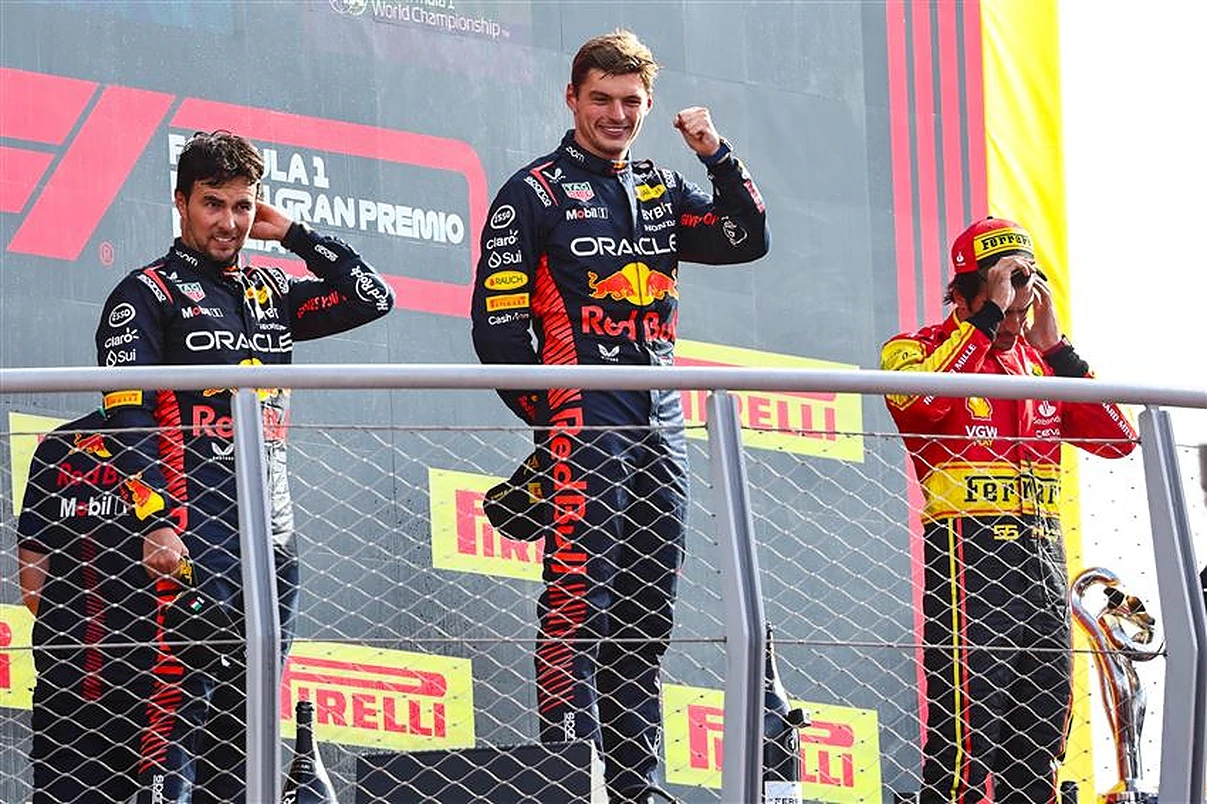
Energy-starved circuits are exposing a clear weakness in Red Bull’s 2026 Formula 1 package, with the problem now expected to follow the team to Belgium and Italy.
Although Red Bull topped the initial internal combustion engine rankings, the team continues to struggle on the electrical side of its power unit, a deficit that grows more costly at specific circuits.
Max Verstappen identified energy-starved tracks as a particular problem area, pointing to Japan and Silverstone as clear examples of where Red Bull falls short against the competition.
Before his crash at Silverstone, Verstappen appeared headed for a podium, but the four-time world champion was brutally honest about what that result would have represented.
“Even if we had finished third, it wouldn’t have been deserved at all,” Verstappen said, reflecting on a deeply difficult weekend for the team.
His struggles were compounded by a combination of balance issues, power unit problems, and a track layout that simply did not suit the characteristics of the Red Bull car.
Silverstone’s abundance of high-speed corners exposed another weakness, as Red Bull has consistently found that fast-corner performance remains one of its less competitive areas this season.
Oliver Bearman and Fernando Alonso have already warned that Spa-Francorchamps can demand even more extreme energy management than Silverstone, raising serious concerns for Red Bull’s prospects in Belgium.
Verstappen acknowledged his favourite track on the calendar will feel completely different this year, responding sarcastically when asked about the upcoming flyaway rounds: “Spa and Monza are going to be great, yeah. And that’s a real shame because Spa is obviously one of my favourite tracks. But this year it’s going to feel very different.”
Team principal Laurent Mekies confirmed the concern, contrasting the team’s pace in Austria with what unfolded just days later at Silverstone, where the car hit significant limitations.
“A week ago in Austria, we were fighting for the win,” Mekies said. “A few days later, here in Silverstone, we were hitting some pretty strong limitations that stopped us from extracting everything out of our package.”
Mekies explained that certain track characteristics are amplifying the team’s weaknesses, leaving Red Bull more exposed compared to its rivals when energy demands increase.
“On tracks where the energy limitations are strong, we seem to be struggling more compared to the competition. In that respect, I’m afraid Spa will probably fall in that category as well,” the team principal added.
Red Bull is studying the Silverstone data to find optimisations, but Mekies acknowledged that the picture is unlikely to change dramatically before the Belgian Grand Prix in just two weeks.
The team’s situation is further complicated by the ADUO token system, which could theoretically allow improvements to the electrical side of the power unit but requires Red Bull to forfeit its position at the top of the ICE rankings.
Because Red Bull Ford currently sits at the top of that classification, the manufacturer is effectively prevented from using tokens to address the electrical deficit at a hardware level.
Mekies remained cautiously optimistic, expressing belief that the team is learning quickly and could still find a path forward: “I trust that the team is learning very quickly, it is still the first year with our team. They are going to get around this sort of energy starving track.”
Within the team, there is greater anticipation for the Hungaroring, a slower and more technical circuit that should be less demanding from a power unit energy management perspective.
“Hopefully, Budapest will give a different picture,” Mekies concluded, suggesting the Hungarian Grand Prix may offer Red Bull a more suitable stage to demonstrate its true potential.