
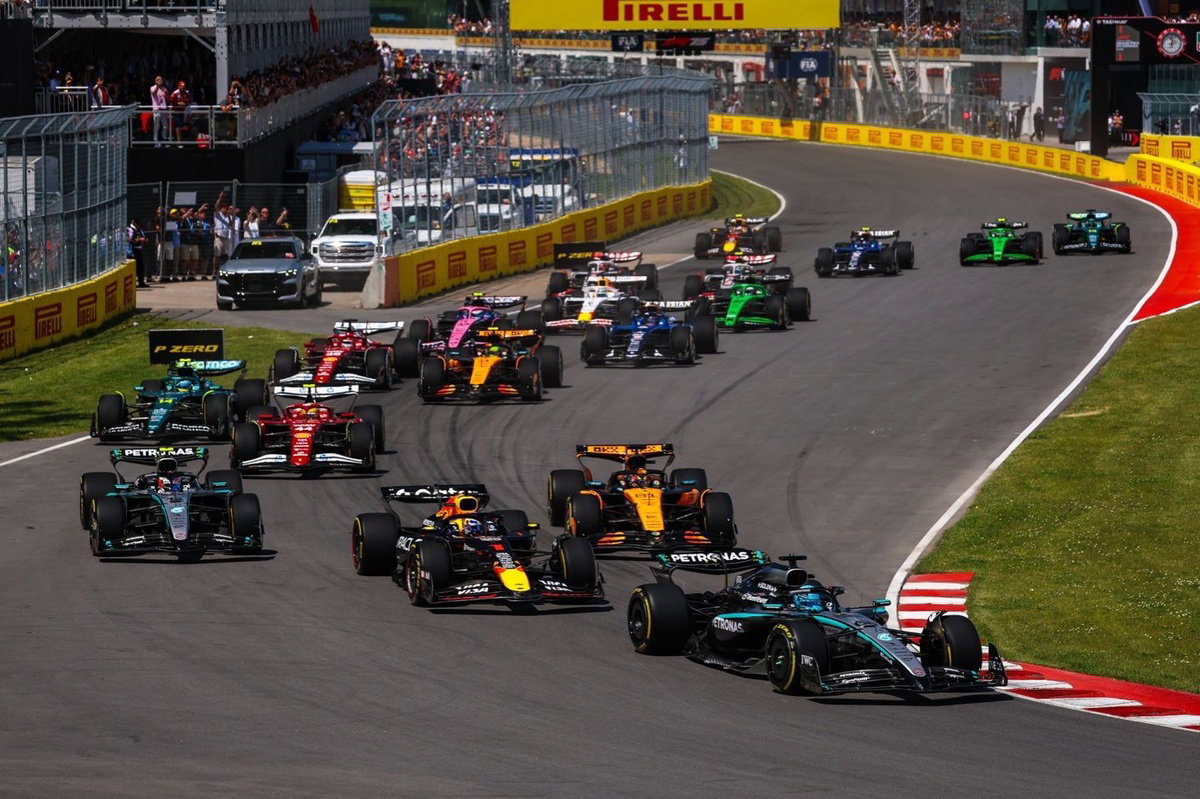
Red Bull is preparing to unleash its second major upgrade package of the 2026 Formula 1 season at the Austrian Grand Prix this weekend.
The team has been on a steady trajectory of closing the gap to frontrunners Mercedes and Ferrari since the post-Japan period of the season.
Team principal Laurent Mekies has been clear-eyed about what the upgrade can and cannot achieve in the fiercely competitive development war that has defined 2026.
“The picture of the season is these performance variations based on who is bringing his upgrade,” said Mekies. “Ferrari made a big step forward. Obviously, our next big one is in Austria. But it’s only as good as the real lap time on track it brings. Everyone in Milton Keynes has been working very hard for that package.”
Ferrari’s upgrade in Barcelona proved transformative enough to deliver Lewis Hamilton a race victory, raising the bar for what a well-executed package can achieve.
Red Bull’s first major upgrade in Miami featured a complete redesign of the RB22’s sidepods alongside the team’s own version of a rotary rear wing, a concept Ferrari team boss Fred Vasseur labelled “Macarena.”
Mekies estimates Red Bull still needs to find around four tenths of a second per lap relative to its rivals, having reportedly halved the gap with the Miami upgrade.
“There is no doubt that the Austrian package alone will not be enough,” Mekies stated. “We know we’ll have some further steps needed. But what is important is that on that continuous closing-the-gap trajectory that we have been onto since post-Japan, is that we continue to get closer, that we don’t talk anymore about four tenths, but hopefully about less.”
Weight reduction is another area where the Austrian package could deliver meaningful gains, with Red Bull still believed to be running above the 768kg minimum weight limit permitted under current regulations.
When asked directly in Barcelona whether the weight reduction plan remained on track, Mekies responded with characteristic humour: “Eat less. That’s my plan. That’s my plan for Austria! And hopefully we get lighter there. Austrian food is good, I know. But the plan is to get the car to eat a little bit less there and to get on a bit of a diet.”
Barcelona exposed some of the RB22’s ongoing weaknesses, with Max Verstappen finishing fourth almost 20 seconds behind Lando Norris in a race where the team lacked pace against Mercedes, Ferrari, and McLaren.
Isack Hadjar lost ground at the start but recovered to sixth, with Red Bull clearly outpaced by the top three teams while remaining comfortably clear of the midfield.
Mekies acknowledged the Barcelona result was an expected reality check, given the circuit’s long straight and mix of mid-speed and high-speed corners exposing the car’s current limitations.
“I think we were expecting that reality check in Barcelona,” he said, pointing out it was the first such circuit since China and Japan where the team faced that particular performance profile.
Mekies was nonetheless encouraged by the broader competitive picture, noting that Ferrari’s strong step forward has contributed to a gradual erosion of the advantage Mercedes held earlier in the season.
“Ferrari has done a very good step forward with their package,” he said. “And, you know, for them to win a race on a track like Barcelona, it says a lot about the quality of chassis plus PU.”
He remained measured about Red Bull’s immediate ceiling, noting the team could fight for podiums in Monaco and Canada but not in Spain, describing the gap as now being about incremental gains across multiple areas rather than one single fix.
“Now it’s not about one single thing anymore,” Mekies said. “It’s about finding a little bit of performance in mid-speed corner, in high-speed corner, on the straight line.”