
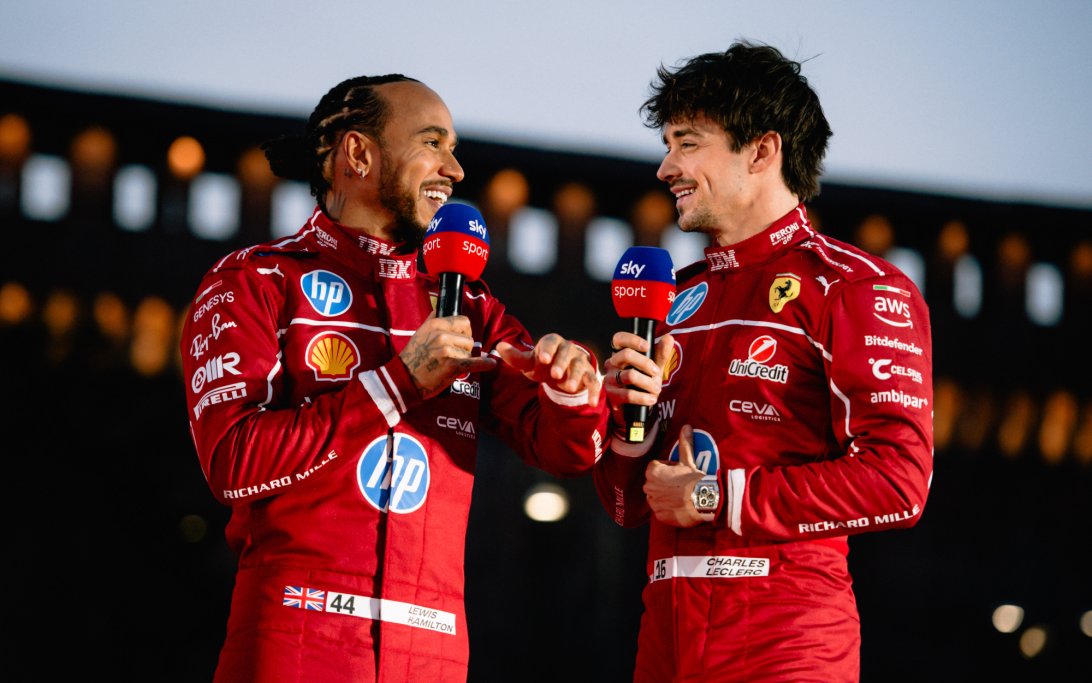
Ferrari’s Charles Leclerc has opened up on his difficult spell during the 2026 Formula 1 season and why mimicking Lewis Hamilton’s approach was simply not on the table.
The new regulations introduced this season presented Leclerc with significant challenges at times, particularly through a difficult run of races spanning Canada, Monaco, and Barcelona.
After comfortably outperforming Hamilton throughout 2025, the head-to-head between the two Ferrari drivers has been far more competitive in 2026, with Hamilton leading qualifying 10-9.
Leclerc has been just 0.023 seconds quicker on average in qualifying, though that figure is distorted by his Q3 crash at Barcelona where he failed to set a time.
During his lowest point, Leclerc was outqualified four consecutive times across the Canadian Grand Prix weekend, Monaco, and Catalonia, while scoring just 16 points to Hamilton’s 64.
Leclerc described whatever was wrong with the car during that spell as “something that was extremely difficult to deal with on the car,” according to his appearance on the Beyond The Grid podcast.
Speaking ahead of the Italian Grand Prix, Leclerc explained the choice he faced when the car was not responding to his natural driving inputs during those difficult weekends.
“You’ve got two options, really. One is to try and find a way around with the set-up and with the car and trying to fit your natural driving style more. The other is just change your driving style,” Leclerc said.
He acknowledged that Hamilton’s form at the time made the idea of adapting his style tempting, but ultimately concluded that replicating another driver’s technique is far more complex than it sounds.
“It’s not as easy as, ‘Oh, Lewis is doing that, I’ll just do the same’. Lewis is an incredibly talented driver and has a natural driving style that is his and he’s the best in the world for that particular driving style. And so to reproduce that is very tricky,” Leclerc said.
Instead of attempting to imitate Hamilton, Leclerc focused on identifying specific areas of the car data that were undermining his own natural style and comfort behind the wheel.
“I saw two, three things on the Friday night in Silverstone, changed those for the Saturday in qualifying, and the feeling was a lot better and even better than it was in Barcelona,” Leclerc explained.
That Silverstone breakthrough proved transformative, with Leclerc qualifying on the front row, just 0.175 seconds behind Mercedes’ Kimi Antonelli and 0.172 seconds ahead of Hamilton himself.
He then led from the start and dominated the British Grand Prix to claim his first victory since 2024, signalling a clear turning point in his season.
A switch to Carbone Industrie brake discs is understood to have contributed significantly to his improved form in the weeks that followed.
Leclerc has since become the third-highest scorer over the last six rounds, accumulating 88 points behind Antonelli’s 121 and Lando Norris’ 107, with only an early Monza crash disrupting an otherwise clean run of top-five finishes.
Hamilton, by contrast, has scored just 66 points over that same period, though brake issues at the Madring race ended his afternoon prematurely through no fault of his own.
Leclerc also made clear that his goal going forward is to drive instinctively rather than analytically, stressing that overthinking behind the wheel is a guaranteed way to lose lap time.
“When you overthink, you know that you are losing time on the table because our sport is not a lot about reacting on what’s happening on the car. It’s more about anticipating and feeling the car yours,” Leclerc said.