
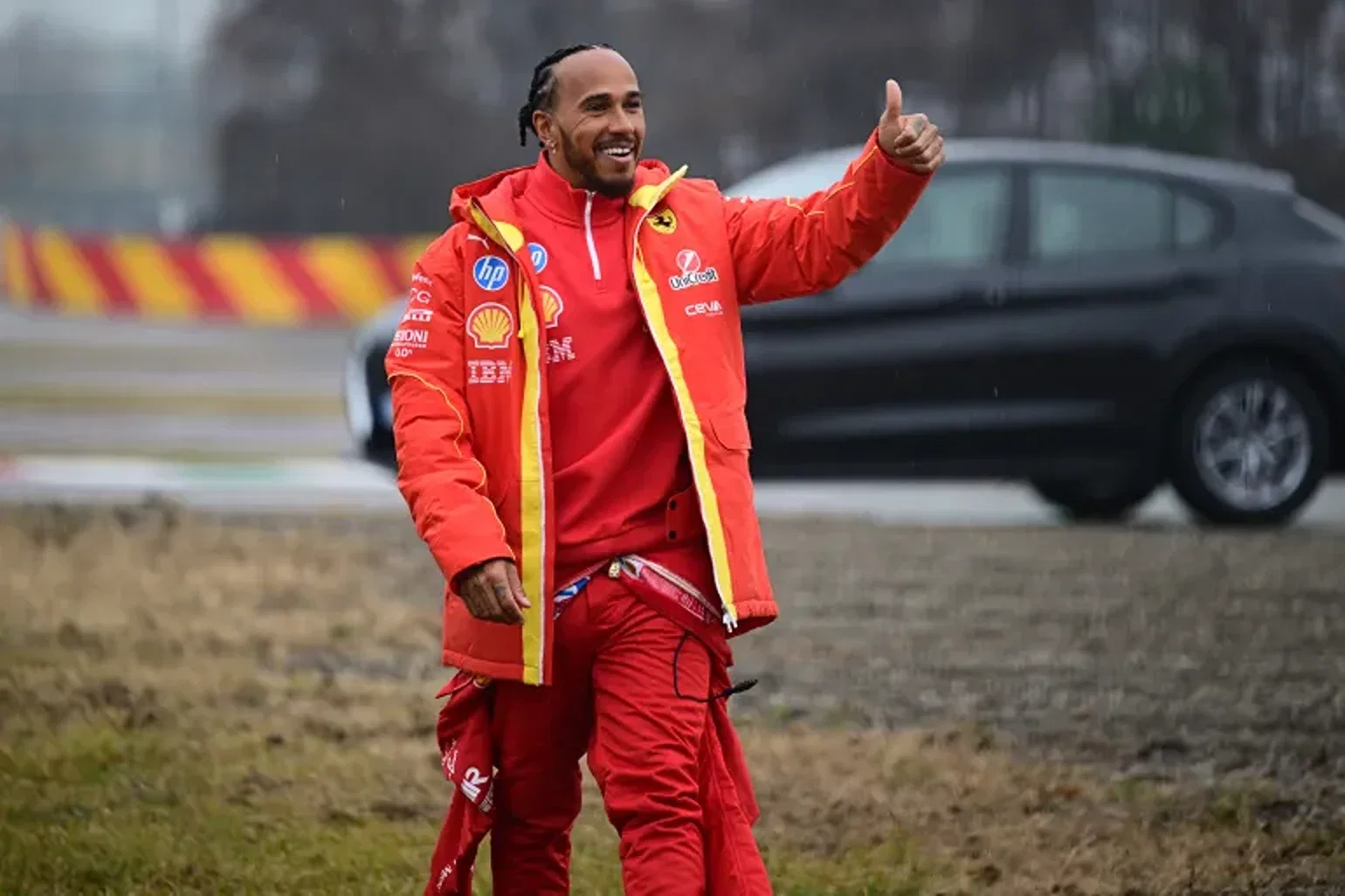
Ferrari team principal Fred Vasseur has shed light on the strategic decisions that frustrated Lewis Hamilton throughout a difficult Dutch Grand Prix at Zandvoort.
Hamilton finished fourth and team-mate Charles Leclerc fifth, marking a second consecutive race without a Ferrari podium following the reverse of that finishing order in Budapest.
The first flashpoint came midway through the race when Hamilton overtook McLaren’s Oscar Piastri but then found himself stuck behind a much slower Leclerc on the tight Zandvoort circuit.
With Hamilton unable to pass his team-mate and calling for team orders that never came, Lando Norris, Kimi Antonelli, and George Russell were able to extend their advantage further up the road.
“Great way of wasting time guys, good job!” snapped a frustrated Hamilton, who was eventually elevated to fourth when Leclerc pitted on lap 43, one lap later than originally planned.
The expectation was that Hamilton would follow suit and take fresh rubber shortly after, but Ferrari kept him out for an extended second stint of 30 laps, which briefly handed him the race lead.
As Norris and Antonelli closed rapidly on fresher tyres, Hamilton found himself powerless, prompting him to radio the pit wall asking, “Are you using me as a guinea pig?”
Both McLaren and Mercedes overtook Hamilton on laps 54 and 55 respectively, with a virtual safety car triggered by Esteban Ocon on lap 55 finally giving Ferrari the opportunity to switch Hamilton to fresh soft tyres.
Vasseur explained that the team deliberately withheld strategic information from Hamilton to avoid tipping off their rivals monitoring team radio communications during the race.
“We didn’t want to tell him the strategy at this stage because we didn’t want to disclose it to the competitors,” said Vasseur. “We wanted to keep him on track until the end, I think it would have been the right call.”
The Ferrari boss also acknowledged confusion around the tyre compounds, noting that the margins between all three compounds were extremely small and difficult to read in real time.
“The difference between the three compounds was very marginal today,” Vasseur said. “It was difficult to have a clear picture on the strategy. Sometimes, we have to change the strategy or adapt, because we are trying to learn from the others.”
Hamilton used his post-race media session to call for “better execution” from Ferrari, pointing to Mercedes as an example of swift and decisive team order implementation during the race.
Mercedes demonstrated that decisiveness on lap 65 when Russell handed second place to championship leader Antonelli after the Italian had taken softs under the virtual safety car while Russell remained on harder tyres.
Russell initially told race engineer Marcus Dudley that “we’ve lost a double podium” as Hamilton closed in, but the Mercedes driver ultimately held on for third and acknowledged post-race that the swap was the right call.
Vasseur himself agreed that execution had fallen short, stating plainly that “the execution today was not that good” when reflecting on how events unfolded across the 72-lap contest.
“The main issue is that we didn’t tell Lewis that we were expecting him to go to the end,” Vasseur admitted. “It was not a matter of pushing.”
The Dutch GP result leaves Ferrari 87 points behind championship leaders Mercedes, with McLaren sitting 75 points back in third and 11 rounds of the season still remaining.