
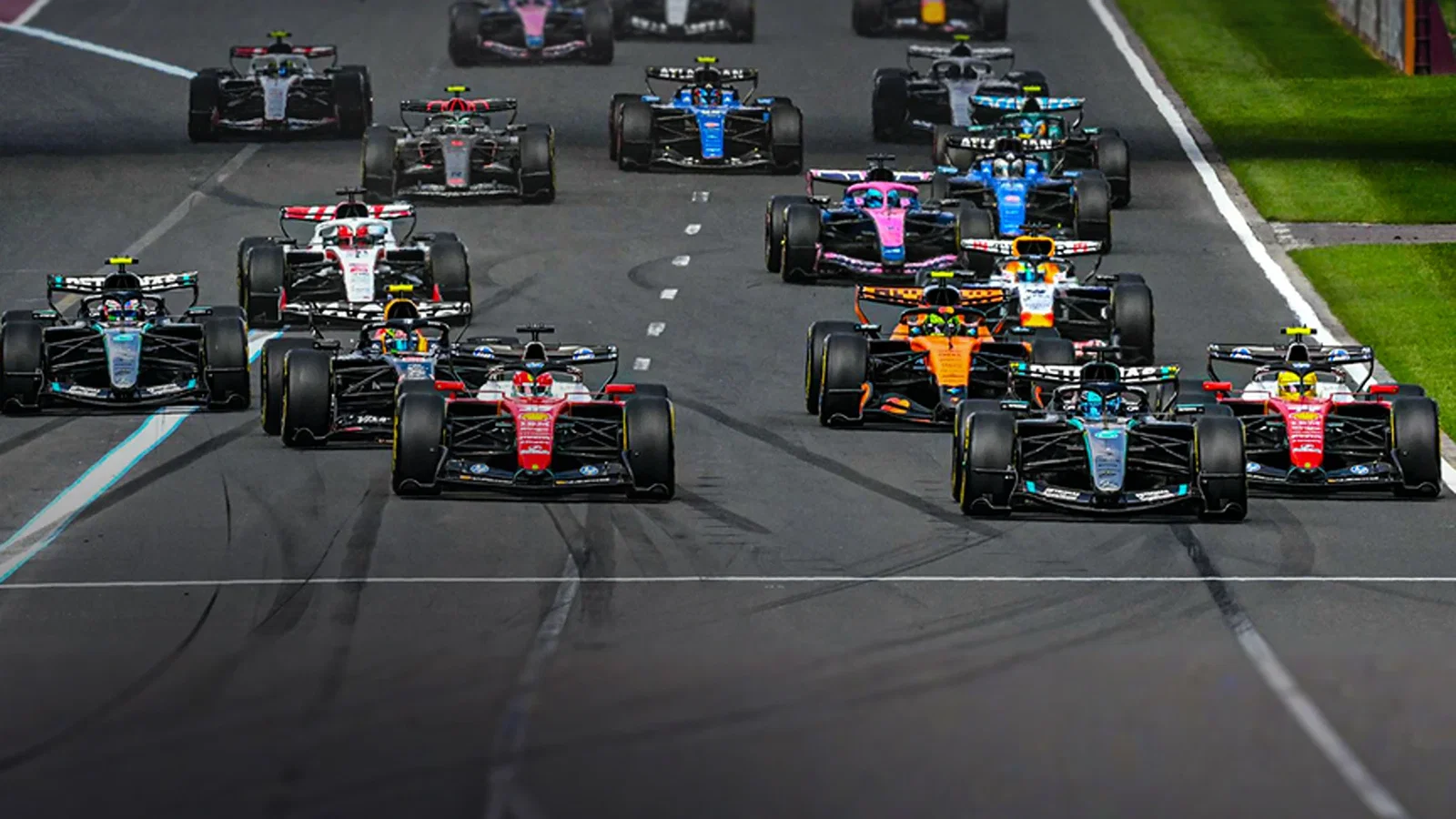
George Russell has brushed aside concerns about energy management at the British Grand Prix, predicting the challenges will actually produce a more exciting race for spectators.
The 2026 Formula 1 season opener in Melbourne divided opinion, with some fans enjoying the chaotic racing produced by the new regulations while others labelled it artificial due to energy deployment splits between drivers.
In subsequent rounds, the energy management effect became less pronounced following changes to allocated deployment and electrical power available to the drivers across the grid.
Silverstone is expected to present the most demanding test yet for the revised regulations, given the circuit’s lack of heavy braking zones that would normally aid energy recovery.
The limited braking around Silverstone will put a premium on energy recovery and lead to a greater concentration of superclipping across a lap, potentially changing the character of the circuit’s many high-speed corners.
Several drivers who have sampled the 2026 cars in the simulator around Silverstone have offered critical opinions, though Russell himself remains largely positive about what the weekend will deliver.
“I think Silverstone will be great,” Russell said. “With these regs, we knew there were going to be some tracks that are more difficult than others for 22 drivers to experience.”
Russell pointed specifically to Melbourne and China as examples where energy-starved conditions actually improved the quality of racing compared to previous years at those venues.
“The tracks that are most challenging for the energy such as Melbourne, China, they have so far produced better racing than we’ve seen in the past of those tracks,” Russell added, acknowledging qualifying pace would likely suffer.
“So you could look at that as the positive. But for sure, a single-lap qualifying is not going to be as fast as we’ve seen in the years gone by,” he continued, accepting the trade-off openly.
When asked whether the cars would feel awful to drive around Silverstone, Russell pointed to his own experience with the 2020 Williams FW43 as context for judging a car’s worth beyond raw pace.
“Throughout my F1 career the fastest race car I drove over the course of a season was probably the 2020 Williams car and we didn’t score a single point in the whole season,” Russell explained candidly.
He noted that his 2020 Silverstone qualifying lap time would almost certainly be faster than what he achieves this Saturday, yet he expects to find far greater satisfaction from being competitive this weekend.
“I loved doing that in Formula 2. Those lap times are 10 seconds slower than what we achieve in F1 now and as I said we’ve got 600,000 fans here this weekend who are also not going to be saying ‘this is awful’,” Russell said.
Russell closed his argument with a pointed historical observation, suggesting that the celebrated cars of the early 2000s produced far fewer overtaking opportunities than modern Formula 1 now delivers in a single race.
“I still think the best race cars in history were the early 2000s cars, but you count the number of overtakes in a season, which is probably the same as the number of overtakes we get in a single race these days. So we can’t have it all,” he concluded.