
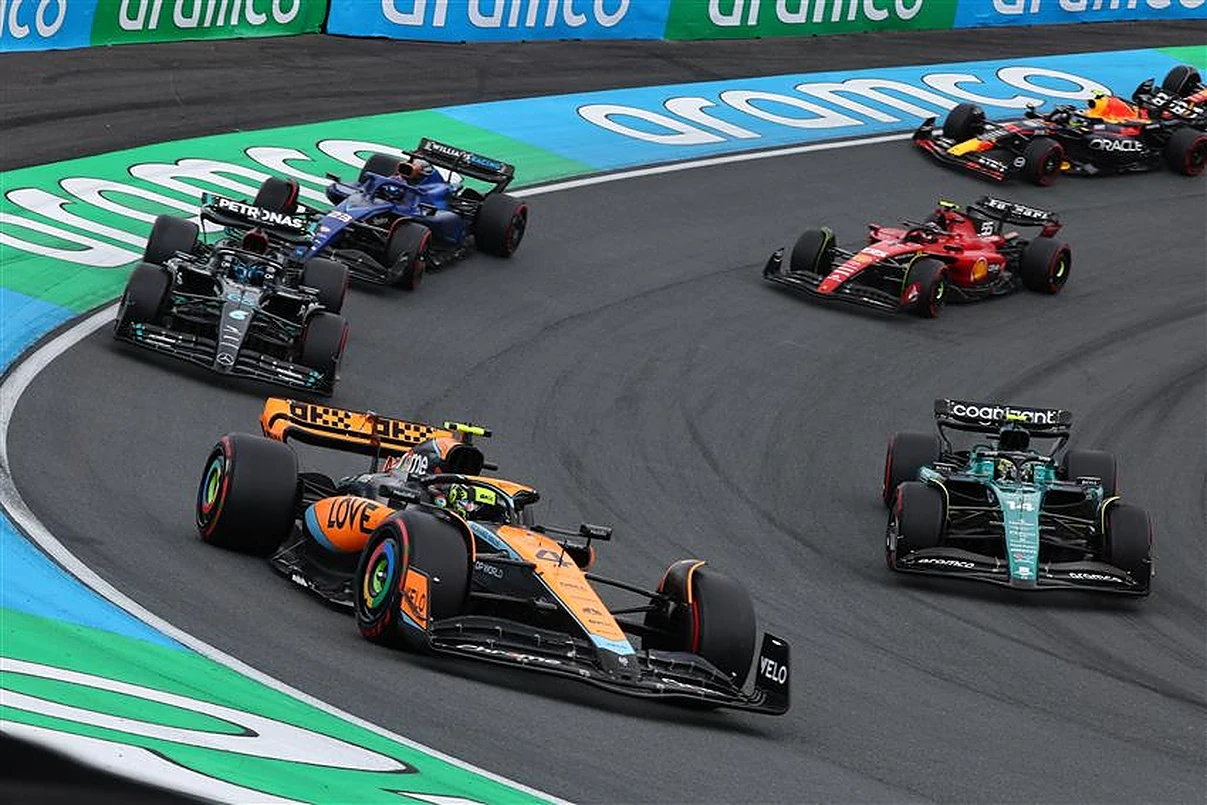
Despite winning two consecutive Formula 1 grands prix, Lando Norris has delivered a stark assessment of McLaren’s title prospects for the remainder of the 2026 season.
Norris currently sits fourth in the drivers’ championship with 159 points, a significant gap behind leader Kimi Antonelli, who holds 242 points after finishing second at the Dutch Grand Prix.
“I don’t have the car I need to fight for a championship,” Norris said following his Zandvoort victory, a striking admission given his recent form at the front of the field.
The competitive picture in 2026 is complicated by distinct performance characteristics spread across the leading teams, making circuit layout a decisive factor in who can challenge for victory on any given weekend.
In broad terms, the McLaren MCL40 excels in high-speed corners, Ferrari’s SF-26 carries strong speed into slow corners, and the Mercedes W17 sits somewhere between the two, creating a constantly shifting pecking order.
“We have a strong car in certain areas,” Norris explained. “It’s not like last year where we were pretty good everywhere. We’re very, very strong in high speed. No one matches us in high speed.”
However, Norris was candid about where the MCL40 falls short, acknowledging that Mercedes holds a significant advantage in slow-speed sections that cannot be ignored.
“Their advantage that they have to us in slow speed is also crazy,” he said. “And therefore I don’t have the confidence to say, yeah, I can easily fight for a championship for the rest of the season.”
Norris pointed to a deeper understanding of what a championship-winning car demands, drawing on his experience from last season when McLaren dominated across a wider variety of circuit layouts.
“I know that’s quite a big comment, but I think last year I understood what is needed from a car and what was needed from me,” he said. “And I know just what I need from the car and what tracks we have coming up where we’re going to certainly struggle more.”
The technical roots of the MCL40’s limitations are linked to McLaren’s decision to run a short wheelbase at the start of the season, which helped save weight but has restricted how much aerodynamic load the team can generate from the floor.
Performance variation between tyre compounds has further complicated Norris’s championship push, with the Dutch GP weekend illustrating the inconsistency McLaren faces depending on which rubber is fitted.
In Saturday’s sprint race on medium tyres, Norris struggled with rear degradation and was overtaken late on by Ferrari’s Charles Leclerc, before a much stronger showing on hard compounds during the grand prix itself.
“We put on the hard tyres,” Norris said. “We were a bit more aggressive with how we wanted to approach the stint. And we turned things around. I had that feeling in the car that I wanted.”
Norris’s driving style demands a highly communicative front end, as he blends throttle and brake inputs together rather than separating them in distinct phases, requiring precise feedback from the front tyres to rotate the car effectively.
McLaren famously redesigned the front suspension geometry with a revised kingpin angle for Norris during last season after he struggled early in the year, underlining just how precisely the car must be tailored to his specific needs.
“When I get what I need from a car, when I have the front I want, when I get the confidence with the rear on entries, I’m going to win a race,” Norris said, capturing exactly what is still missing on certain circuit types.
Championship leader Antonelli added further context after the Dutch GP by suggesting Mercedes may now only have the third-best car overall, meaning the midfield battle at the top of the standings remains genuinely complex.
“It’s clear where our weaknesses are,” Norris concluded. “Therefore we need to attack those things. And until we do that, it’s still going to be a very tough end of the season.”