
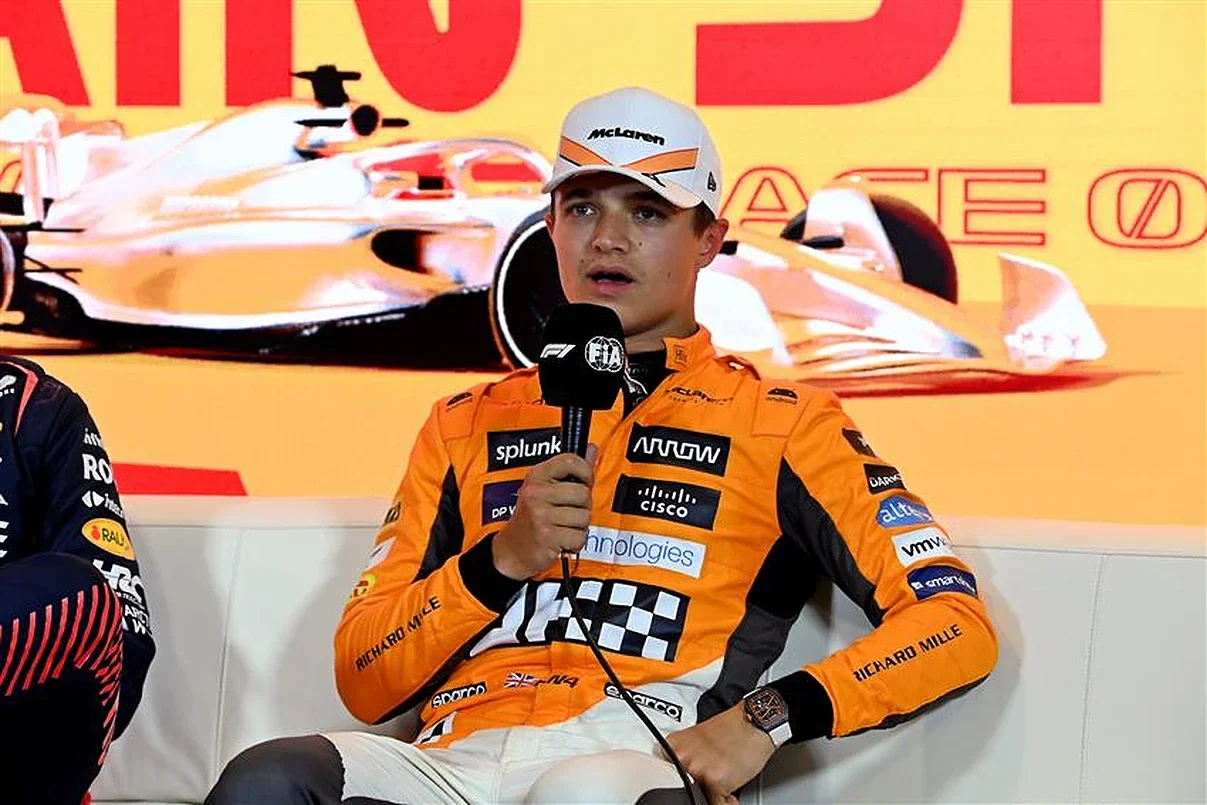
Lando Norris calling for Franco Colapinto to be suspended by the FIA following the Azerbaijan Grand Prix raised a fascinating question about F1’s history of race bans.
Colapinto triggered the controversy after causing a multi-car pileup in Baku that eliminated both the McLaren of Norris and Alpine’s Pierre Gasly on Saturday.
Norris has since apologised for his comments, and Colapinto ultimately received only a five-place grid penalty for the Malaysian Grand Prix rather than a suspension.
However, eight drivers throughout Formula 1’s history have not escaped so lightly, with some of the sport’s biggest names among those forced to sit out races.
The most severe ban in F1 history was handed to Eddie Irvine in 1994, after he caused a four-car collision at the season-opening Brazilian Grand Prix while driving for Jordan.
Jordan’s appeal against the initial one-race ban backfired dramatically, with the FIA extending Irvine’s punishment to three races, ruling him out of the Pacific, San Marino and Monaco Grands Prix.
Michael Schumacher also found himself banned in 1994, after overtaking pole-sitter Damon Hill on the formation lap before the British Grand Prix and then failing to serve his five-second time penalty when instructed.
The FIA showed Schumacher a black flag, which he initially ignored before pitting to serve his original penalty, finishing second on track before his disqualification was confirmed and a two-race ban imposed.
Benetton’s appeal allowed Schumacher to race in Germany and Hungary, but when that appeal was rejected he was forced to sit out rounds at Monza and Estoril.
Nigel Mansell received a one-race ban and a $50,000 fine after overshooting his pit box at the 1989 Portuguese Grand Prix, reversing back in, ignoring the black flag shown to him, and eventually colliding with Ayrton Senna.
That ban ruled Mansell out of the following Spanish Grand Prix, a significant punishment for one of the sport’s most celebrated drivers.
Mika Hakkinen also fell foul of the stewards in 1994, receiving a suspended one-race ban after a collision with Rubens Barrichello at the British Grand Prix, which was activated when he caused a multi-car crash in Germany.
The future two-time world champion was forced to miss the Hungarian Grand Prix, much to the dismay of then-McLaren chief Ron Dennis.
Jacques Villeneuve was given a suspended race ban in 1997 for ignoring yellow flags at Suzuka, one of five drivers punished after a crash involving Jos Verstappen, but his ban was activated immediately because he had committed the same offence three times earlier that season.
Williams appealed with insufficient time for a hearing, allowing Villeneuve to race in Japan, but his two points were later stripped, leaving him one point behind Michael Schumacher heading into the season finale before he ultimately won the title by three points in Jerez.
Kevin Magnussen holds the distinction of being the most recent driver to receive a race ban, missing the 2024 Azerbaijan Grand Prix after his penalty points total reached 12 following an incident at the Italian Grand Prix.
Romain Grosjean sat out the 2012 Italian Grand Prix after causing a massive multi-car pileup into turn one at Spa, one of the most notorious incidents of that era.
Riccardo Patrese missed the 1978 United States Grand Prix not through an official ban but because fellow drivers pressured event organisers to suspend him following a 10-car crash at the Italian Grand Prix, after which Ronnie Peterson later lost his life in hospital.
Patrese was eventually acquitted of manslaughter in a Milan court in 1981, legally cleared of any fault for that devastating crash nearly three years after the event.