
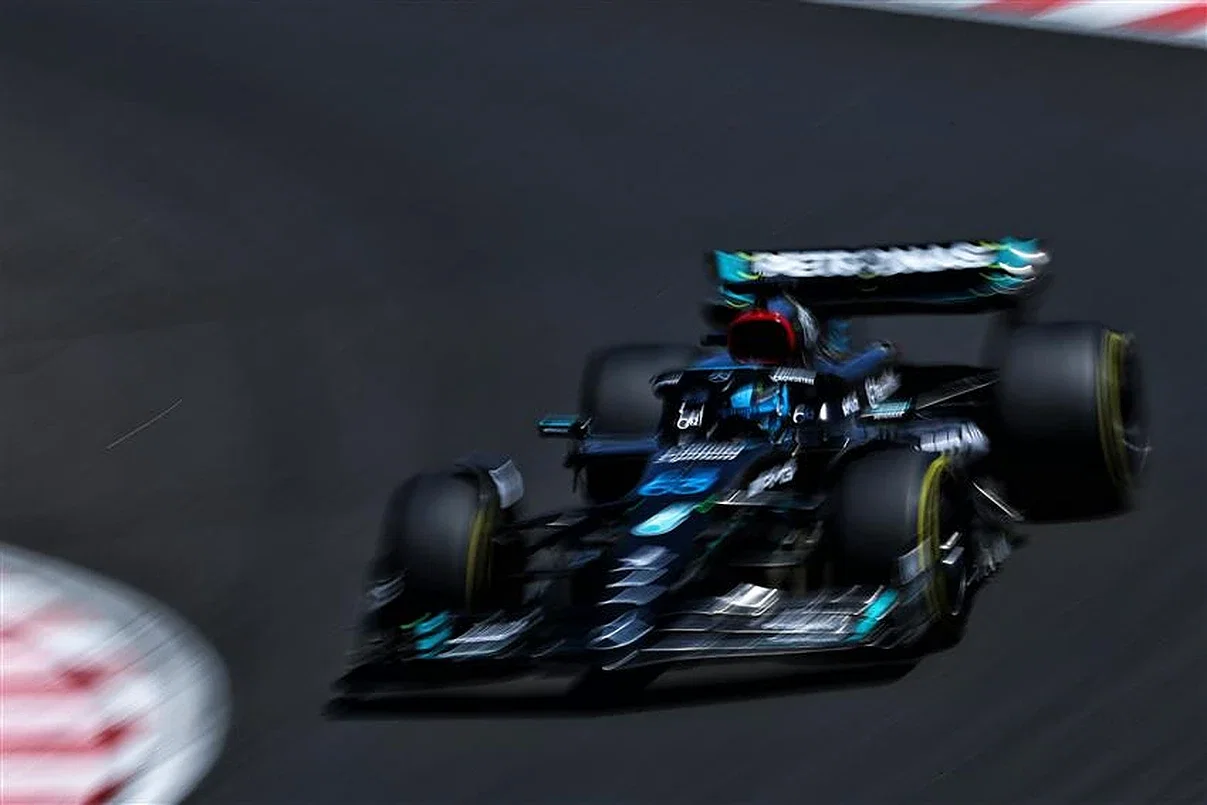
George Russell’s troubled Hungarian Grand Prix weekend was compounded by a Mercedes engine software failure that left him almost stationary off the grid.
The chaos came just one day after Russell had already been forced into an engine change following a water leak caused by hitting a kerb during Saturday’s session, destroying his original unit entirely.
When the lights went out on race day, an anti-stall trigger cost Russell multiple positions and served as a painful symbol of his frustrating first half of the 2026 season.
Russell himself admitted after the race that he desperately needs a break to recharge, having accumulated more regrets than rewards across the opening months of the campaign.
The Budapest weekend was never going to be straightforward, with Russell conceding that even without the technical dramas, a top-three qualifying result would have been unrealistic given the pace available.
Over the team radio at the start, Mercedes initially suggested that Russell may have lifted off the throttle during the launch procedure while the engine was revving high to build the necessary boost.
However, data confirmed that while Russell did reduce his throttle input from around 30% to below 10% while the lights were still on, this was a reaction to the problem rather than its cause.
Toto Wolff was clear in his assessment after the race, stating: “It looks like that he gave about 10% throttle and the whole thing revved maximum, he went off the throttle and it popped down, so I’m really not happy about too many mistakes that happened. So that was the reason and then he drove very well.”
Wolff also told Sky Sports that the level of reliability issues and technical failures seen across the first part of the season is simply unacceptable for a team of Mercedes’ standing.
Russell’s own explanation after the race aligned precisely with what the telemetry data revealed, confirming that the engine began misbehaving before he ever touched the pedal differently.
“I was on the throttle holding the revs, and then all of a sudden, about four seconds before the lights went out, the engine just started revving all over the place. And I was reacting with my throttle, and it wasn’t doing anything. So, the engine wasn’t reacting to the throttle,” Russell explained.
A comparison with team-mate Kimi Antonelli illustrates just how severe the problem was, with both drivers initially following identical procedures during the five-second preparation period introduced this season.
While Antonelli’s throttle input and engine speed remained stable at roughly 12,300rpm, Russell’s engine climbed past 12,700rpm and briefly spiked as high as 12,800rpm, an exceptionally high value at that stage.
Russell attempted to bring the revs under control by lifting almost entirely off the pedal, but even that failed to stabilise the engine speed, which dropped below 12,000rpm before surging back to around 12,600rpm on under 10% throttle.
When the clutch was released, Antonelli’s engine sat at around 5,800rpm to generate proper launch momentum, while Russell’s had dropped to just 4,500rpm, leaving the car without sufficient drive and triggering anti-stall.
Remarkably, Russell revealed that this was not an entirely new problem for the team, saying: “It was obviously a brand-new engine. I think it was something we had seen in pre-season at one point, but I have no idea.”
The failure compromised Russell’s entire race and added yet another chapter to what has been a deeply difficult stretch for the British driver heading into the summer break.