
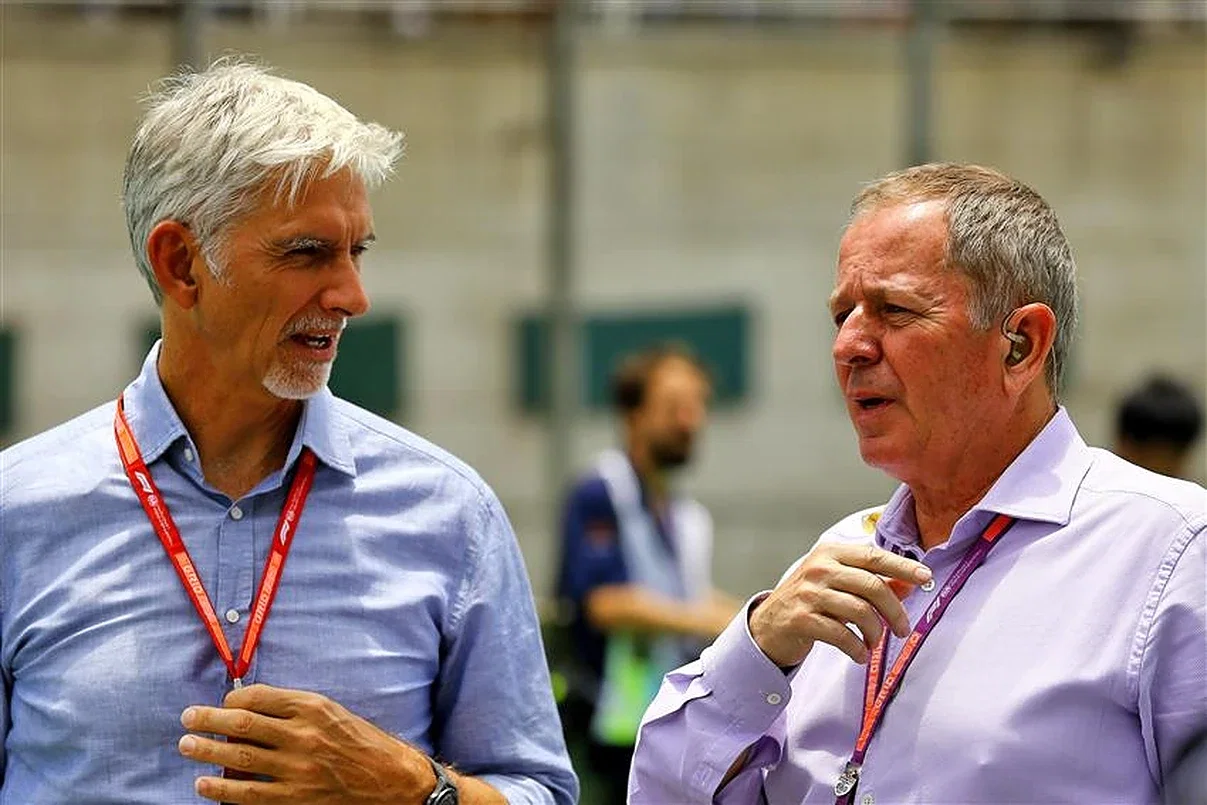
1996 Formula 1 world champion Damon Hill has opened up about the circumstances that led to him losing his Williams seat despite clinching the drivers’ championship.
Hill won the title that year, finishing ahead of rookie teammate Jacques Villeneuve in the standings, yet Williams had already moved on before the season was even over.
Heinz Harald Frentzen was officially announced as Hill’s replacement at the Italian Grand Prix, with some reports suggesting the deal had been agreed considerably earlier than that announcement.
Hill believes that Michael Schumacher’s dominance and the resulting commercial pivot towards Germany played a significant role in Williams’ decision to replace him with a German driver.
Schumacher had won back-to-back world championships at Benetton in 1994 and 1995, beating Hill on both occasions, before making his high-profile move to Ferrari ahead of the 1996 season.
That shift in F1’s commercial landscape towards Germany made signing a German driver a strategic priority for teams looking to capitalise on the sport’s booming new market.
“I think that in 1995, [Williams bosses Frank Williams and Patrick Head] probably looked at what happened and decided ‘we need to think of the future’,” Hill told F1.com.
“And one of the things that’s come to light for me over time is there was a movement towards Germany as far as the market went in F1, because of Michael [Schumacher].”
Hill also pointed to Williams’ long-term ambition to secure a BMW engine deal as another key factor, with the team eventually using BMW power units from 2000 through to 2005.
“I think that… the move towards BMW was a strategy, and I think a German driver was key to that,” Hill explained, noting that Frentzen was seen as a future star in German motorsport circles at the time.
Hill recalled a frank conversation with team principal Frank Williams, who offered little explanation beyond a vague reference to the future of the team when delivering the news.
“When Frank told me that they were going to get rid of me, he said, ‘I have to think of the future of the team’. That was his answer, his excuse. And I went, ‘I’m not the future, why is that?'”
The revelation underlines how even a world championship title offers no guarantee of job security in Formula 1, with commercial and political factors often proving just as decisive as on-track performance.
Hill summed up the situation bluntly, noting that no matter what he had achieved in 1996, his fate at Williams had already been sealed well before the season reached its conclusion.
“But basically, it didn’t matter what I did in ’96. Frank had already got two drivers signed up in ’97. So there was no room in the inn.”