
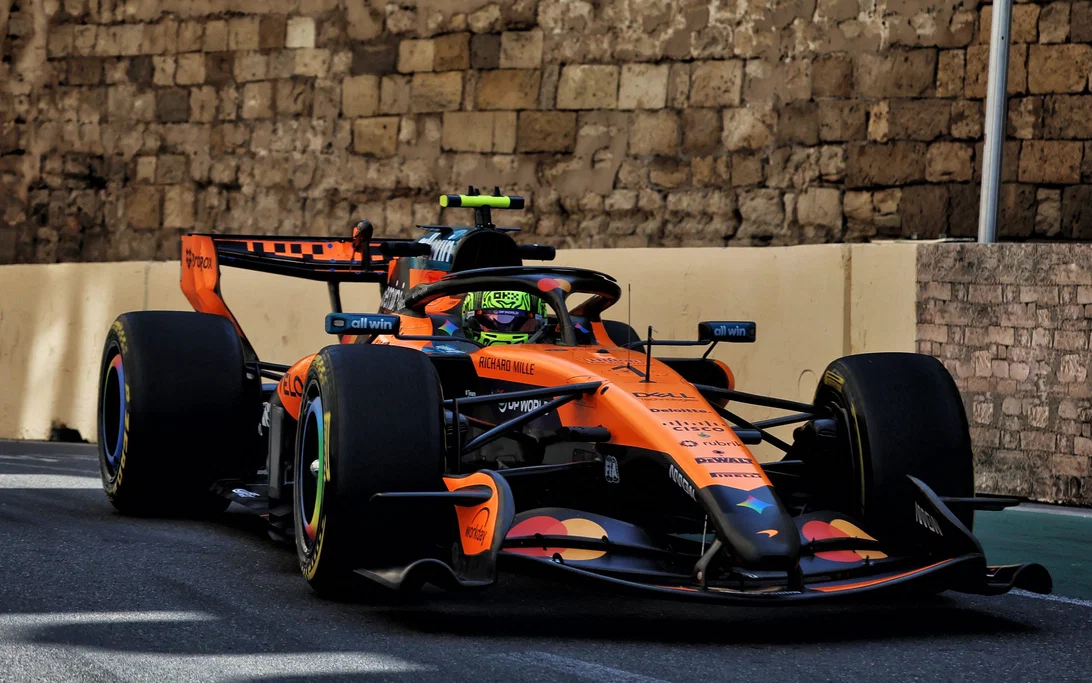
Lando Norris was left confused after a technical problem robbed his McLaren of top-end performance during Azerbaijan Grand Prix qualifying in Baku.
The reigning world champion qualified fifth, three tenths behind teammate Oscar Piastri in Q3, marking his worst deficit to his teammate all season.
Norris had outqualified Piastri in nine of the previous ten sessions, making the gap at Baku all the more surprising and difficult to explain.
A lock-up in Q3 did not help matters, but the underlying issue was a measurable power deficit affecting Norris’ MCL40 specifically.
Norris addressed the problem directly after the session, saying: “There’s more in my car for some reason than the other car.”
He added: “So we have to understand why I’m basically having to push more than Oscar to try and make up for my straightline speed.”
Norris’ top speed was 3.4km/h slower than Piastri’s across the qualifying runs, prompting the team to investigate the root cause immediately.
McLaren team principal Andrea Stella confirmed the team had already identified a likely explanation linked to the power unit’s fuel delivery behaviour.
“On Lando’s side specifically, we observe a deficit of power that we are investigating,” Stella said, explaining the situation after qualifying had concluded.
“It seems to be linked to some behaviour of the fuel injection, something that hopefully we, or the adaptive systems, should be able to improve for tomorrow,” he continued.
Stella was careful to clarify the issue was isolated, adding: “It looks that occasionally the power unit generates a bit less power, but this is a specific phenomenon, a specific issue.”
He stressed: “It has nothing to do with the overall behaviour of the power unit,” distancing the problem from any broader reliability concerns heading into race day.
The fuel injection fault sat within a larger context of McLaren struggling for straight-line performance relative to Mercedes, their own engine supplier.
George Russell was 8.1km/h faster than Piastri and 11.5km/h quicker than Norris in Baku, underscoring the scale of the gap between the two teams.
Norris acknowledged the wider problem went beyond the isolated fault, pointing to differences in both car efficiency and power unit exploitation between McLaren and Mercedes.
“It’s both,” Norris said when asked whether the gap was down to engine performance or aerodynamic drag. “They have a very efficient car, they always have done for years.”
He went further, warning: “We need to take a big step in that direction if we want to be competitive in any straightline-speed track for the rest of the season.”
Stella echoed those concerns, noting that Mercedes had demonstrated superior top-speed capability throughout Baku practice and qualifying across every session.
“While we have the same power unit, there’s a few differences, and I think it’s fair to say that their package, chassis, ratios, power unit itself, it just seems to be more effective when it comes to generating top speed,” Stella explained.
He pointed to Monza as further evidence of the gap, with Mercedes consistently extracting more straight-line performance at high-speed venues throughout the championship.
Stella acknowledged drag reduction remains an area McLaren must address, concluding: “As a fact, we think it’s an opportunity to do better.”