
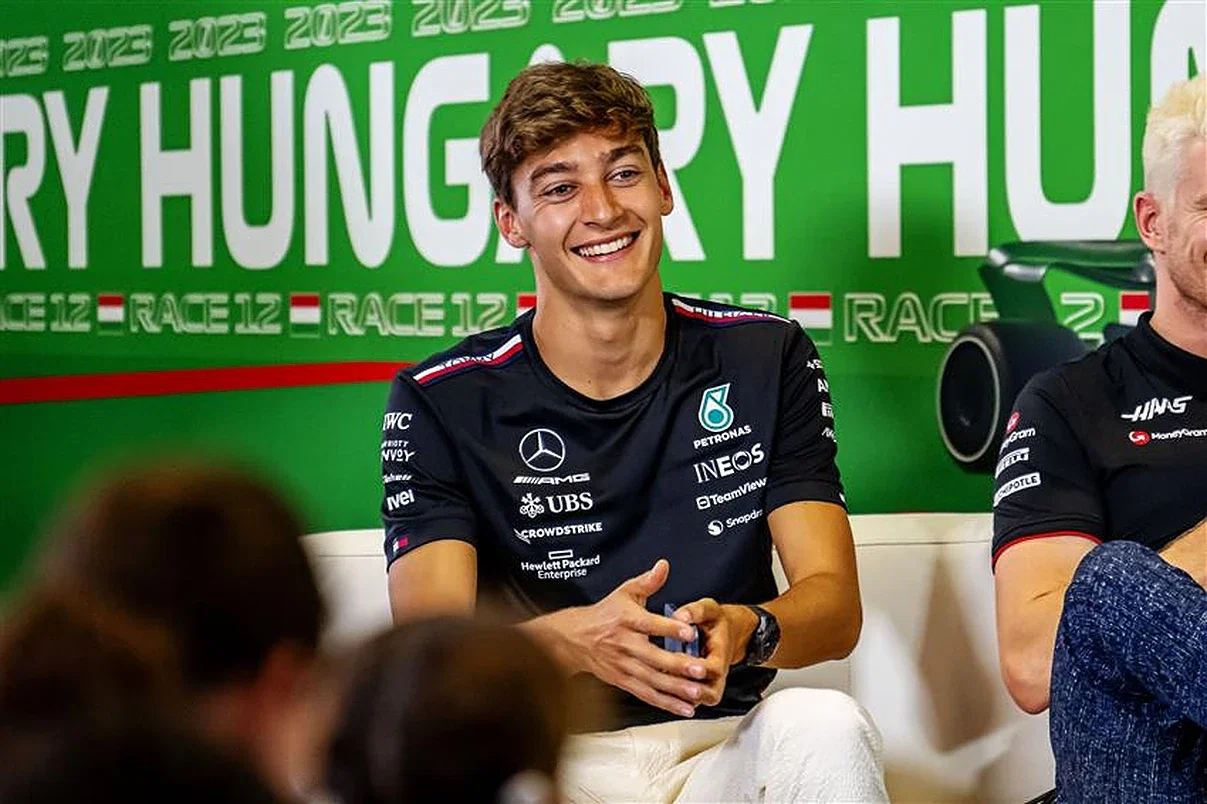
George Russell has endured one of the most difficult stretches of his Formula 1 career in 2026, falling from pre-season title favourite to struggling to keep pace with teammate Kimi Antonelli.
The Briton has been forced to fundamentally question his approach to driving, with the peculiar demands of the 2026 technical regulations appearing to actively work against his natural style.
Russell is among a group of drivers whose instinctive technique puts them at a disadvantage relative to their teammates under the current formula, most visibly at Silverstone and Spa.
At those circuits, Russell recorded lower peak top speeds than Antonelli on key straights, a consequence of using fractionally more electrical power to re-accelerate after scrubbing off more speed through preceding corners.
McLaren’s Oscar Piastri has also been identified as a driver facing similar difficulties within his team environment this season.
Ahead of the Azerbaijan Grand Prix in Baku, Russell was asked whether incoming 2027 tyre compounds from Pirelli could help restore a more natural driving style for affected drivers.
“I think it’s been clear this season that the tyres, front to rear, probably have not been well balanced enough,” he said, pointing to the added stress modern power units place on rear rubber.
Russell also referenced feedback from Antonio Giovinazzi, who drove the current generation of car for the first time in Imola just days before the Baku weekend and was struck by its off-corner power delivery.
“I spoke with Antonio Giovinazzi, who drove this new generation of car for the first time a couple of days ago in Imola, and he said how impressed he was at the power of these new cars off the corner,” Russell explained.
The Mercedes driver believes the existing Pirelli compounds were developed alongside the previous, less powerful generation of power unit, meaning the rear tyre stress seen in 2026 was not fully anticipated during that process.
Pirelli has historically struggled to hit its target of producing tyres with a defined performance window followed by rapid degradation, a brief originally inspired by the unpredictable 2010 Canadian Grand Prix.
For 2027, Pirelli’s development focus has included not only widening the lap time gaps between compounds but also improving the front-to-rear balance, which could theoretically benefit drivers like Russell who lose momentum through rear sliding.
However, Antonelli offered a more measured assessment of how much impact the new tyres alone would actually deliver, suggesting the aerodynamic changes arriving alongside them are the more significant factor.
“I think the tyres won’t be so much different, probably the front tyre will change a little bit, and in terms of structure a little bit, we’ll see what Pirelli decides,” Antonelli said when asked about the magnitude of the expected change.
The Italian highlighted that aerodynamic rule changes, particularly around the floor’s bib area, will have a considerable impact on how cars behave, with teams having already revised plans to carry over their 2026 chassis.
“The car will be different, on the aero side the car is changing, especially around the bib area, there’s going to be a big change, which is going to implement aero loss,” Antonelli added.
The specific aerodynamic changes include fewer vortex generators on the floor leading edge and a dramatically shortened tea tray, reduced from 900mm to 600mm, opening up new possibilities around rake angle design philosophy.
Antonelli concluded with a characteristically pragmatic outlook, noting that adapting to whatever conditions emerge is ultimately the key skill required of any driver.
“It’s all about adapting at the end of the day, so we’ll see,” he said, a sentiment that carries particular weight given how effectively he has already adapted to the 2026 regulations compared to Russell.