
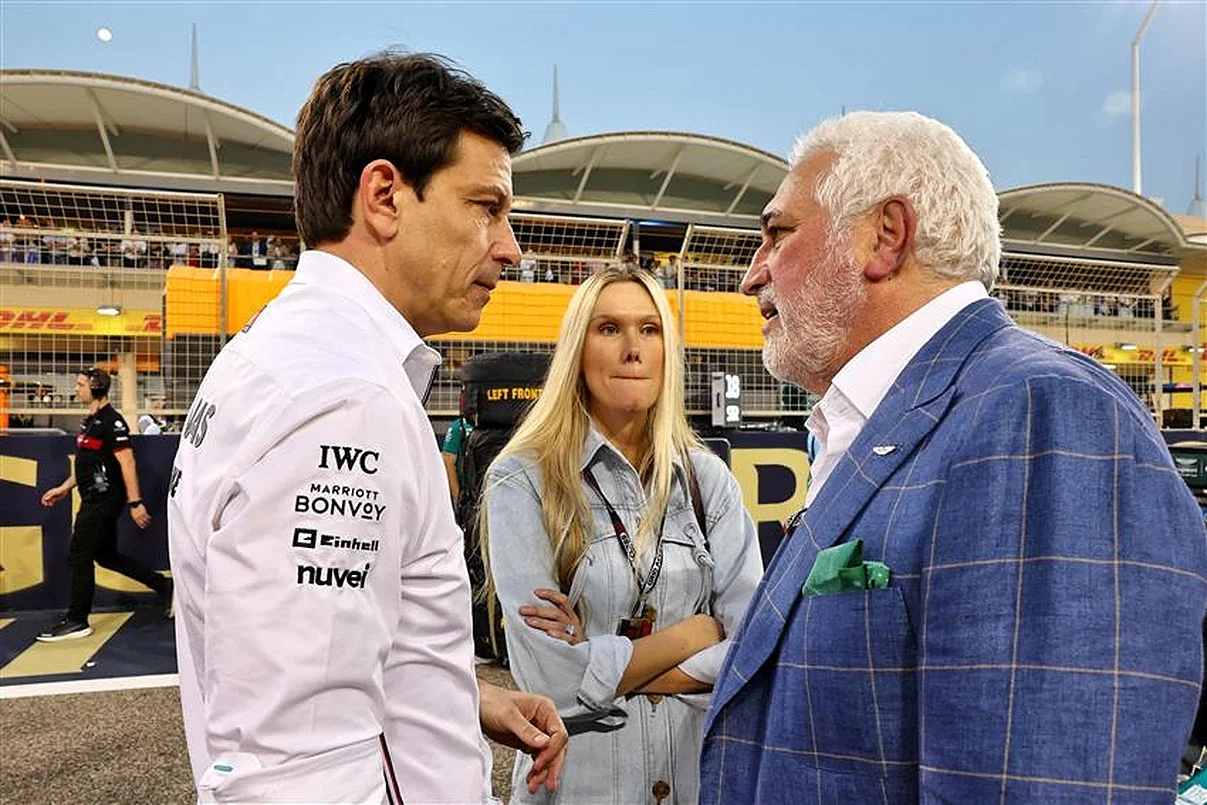
Mercedes boss Toto Wolff has explained why the team chose not to pit George Russell during the virtual safety car period at the Italian Grand Prix in Monza.
Kimi Antonelli claimed a stunning victory at his home race, winning from 19th on the grid after a strategy call split the two Mercedes drivers during the closing stages.
Mercedes placed Antonelli on medium tyres following an early red flag, which was the only viable option for the young Italian given he had started the race on harder compounds.
Russell, meanwhile, started on mediums and switched to hards after the race was halted due to Charles Leclerc’s crash, remaining on that tyre for the rest of the grand prix.
When Lance Stroll’s stoppage triggered a virtual safety car on lap 27, Mercedes used the window to bring Antonelli in for a fresh set of mediums, a move that would prove decisive.
Wolff confirmed that at the time of the call, the team’s own software actually predicted Russell’s one-stop strategy would come out ahead of Antonelli’s two-stop approach.
“We didn’t know what was the better strategy,” Wolff said. “At that stage, the system said that the one-stop comes out ahead. That two-stop was coming close to the end, but wouldn’t catch. So that’s what the software said.”
Wolff added that splitting the strategies was always the logical approach given the uncertainty surrounding tyre performance across the race distance.
“In the morning meeting we said the hard tyre is going to go forever. You can start on it and finish on it and you can see with George it was a forever tyre but it didn’t have the performance that of the medium.”
The team noticed tyre abrasion data, including on a McLaren, which helped confirm the decision to bring Antonelli in despite the Italian reporting his tyres were in good condition at the time.
“We didn’t talk to Kimi about the stop,” Wolff confirmed. “We asked for the state of the tyre and he said, ‘Well it’s actually good’ but it was clear that we saw abrasion and I think it was on Lewis’ car. We saw some abrasion on a McLaren. So it was the right thing to do.”
Wolff was also quick to credit Antonelli for the way he managed the medium tyres across such a long stint after the stop.
“Kimi was able to extract 35 laps or 40 laps from that tyre in a consistent way and that’s certainly his skill.”
Russell said he felt he was well-positioned to win the race on his existing strategy before the virtual safety car changed the picture entirely.
“I would have loved to have continued on the same strategy,” Russell said. “Because I felt in a good position in that battle. I knew exactly what I needed to do with the energy management to defend but also when to attack.”
Russell acknowledged that the VSC arrived at a critical and arguably perfect moment for drivers who were considering a second stop.
“Then of course when the VSC came out, it came out at that perfect point for the drivers to pull the trigger and take the pitstop.”
The British driver also noted that covering Max Verstappen from a team strategy perspective made splitting the two Mercedes drivers a sensible decision for the pit wall.
“When we had Max in the mix as well from a team perspective, you’re covering off both scenarios. So, today Kimi did a great job.”
Despite his disappointment, Russell was generous in his praise for Antonelli, though he maintained the outcome could have been different without the VSC intervention.
“But, it takes nothing away from Kimi’s drive altogether. It would have been very interesting to see how the race would have panned out if there was no VSC.”
Following the result at Monza, Russell now trails Antonelli by 66 points in the Drivers’ Championship.