
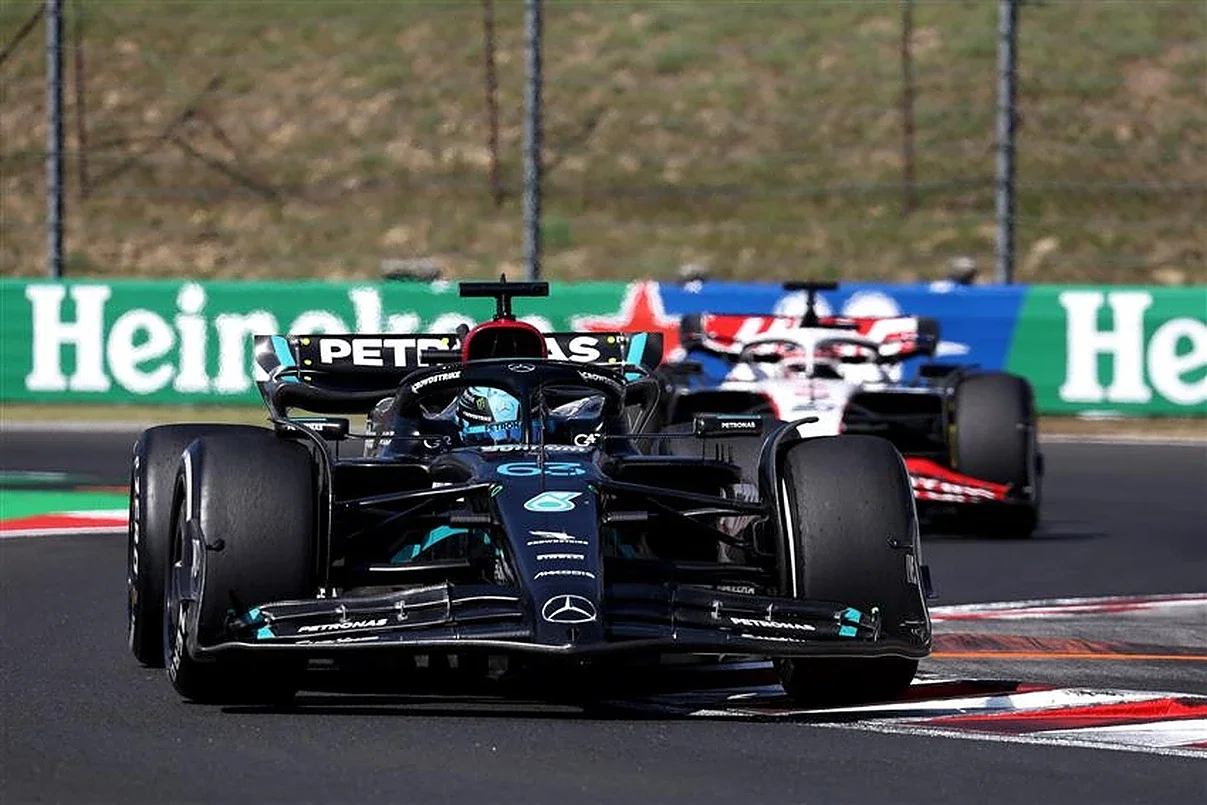
Two years on from one of the most painful moments of his Formula 1 career, George Russell has revisited his Belgian Grand Prix disqualification in striking detail.
The Mercedes driver was speaking to team sponsor SAP when he was asked to relive the events of that dramatic July 2024 race at Spa-Francorchamps.
Russell had driven a flawless race to cross the line in first place, ahead of his then team-mate Lewis Hamilton, who is a seven-time world champion.
The celebrations were quickly extinguished when a post-race weighing of his W15 revealed the car was 1.5 kilograms below the FIA minimum weight requirement of 798kg.
Russell explained that the race was always planned as a two-stop strategy, a plan that every driver on the grid was expected to follow that afternoon.
However, around ten laps into his stint following his first pit stop, the 28-year-old British driver began to feel confident enough in his tyres to consider a radical change of approach.
“After my first pit stop, I was about 10 laps into my stint and I was like ‘I feel good here, these tyres feel good and I think I can make it to the end of this race,'” Russell explained.
He then got on the team radio to raise the idea, saying “let’s consider the one stop – I’m feeling good,” prompting Mercedes to begin assessing whether the undercut could work.
The team warned him he was on course to be caught by Hamilton with two laps remaining, which meant Russell could not afford a single error in the closing stages.
He held on to take what appeared to be the third victory of his career, climbing the podium and celebrating with the crowd before the bombshell news arrived around twenty minutes later.
Russell went into considerable technical detail about why the weight discrepancy occurred, explaining that Mercedes calculate how much mass the car sheds across a race distance through fuel burn, brake wear, floor scraping, and tyre rubber loss.
The single pit stop proved to be the decisive factor, as Russell’s tyres had less rubber remaining on them compared to Hamilton’s fresher set, leaving his car approximately one kilogram lighter in that area alone.
“Because I had only done one pit stop, I had much less rubber on my tyres,” Russell said, adding that his team-mate’s fresher rubber was heavier and that difference pushed him over the edge of the regulation limit.
Despite the devastating outcome, Russell said with clarity that he stands fully behind the decision he made on that afternoon, and would make the same call again without hesitation.
“I was in fourth place before the pit stop and I thought, well, if I get this wrong I could end up in fifth, sixth or seventh. If I get this right I can win the race,” he said.
Russell concluded his reflection with a philosophy that captures the essence of racing at the highest level, stating: “Risk and competition go hand in hand,” before adding, “in that moment it was clear the reward outweighs the risk and I was willing to do it.”