
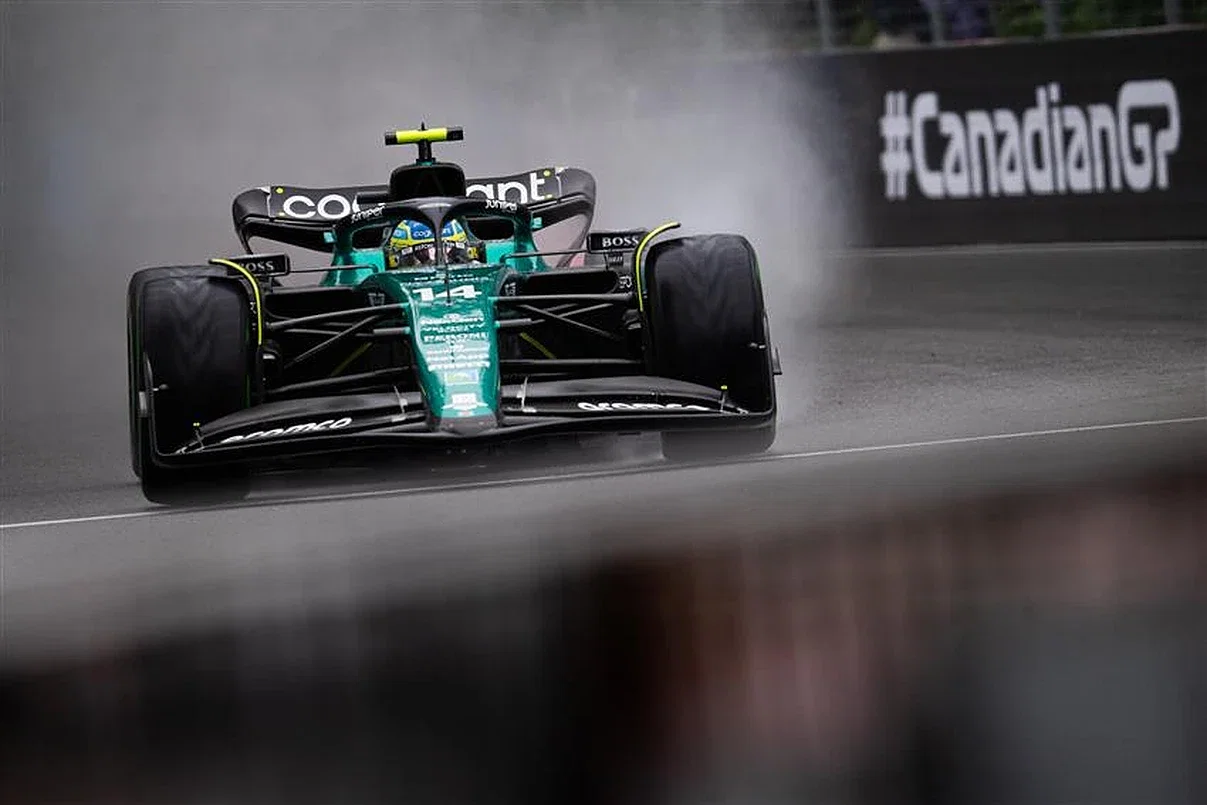
Aston Martin arrived at the Hungarian Grand Prix carrying its most significant upgrade package of the 2026 Formula 1 season, and the results have been measurable.
Fernando Alonso broke into Q2 at the Hungaroring, marking the first time the team had progressed beyond the Q1 elimination zone in a full qualifying session all year.
The upgrade package was comprehensive, with the front end receiving a significant redesign alongside reworked sidepods, an updated floor, and revisions to the rear of the car.
Aston Martin had been forced to delay its aerodynamic updates until Hungary after a spate of reliability issues set the team back significantly at the start of the season.
A statistical analysis of Aston Martin’s qualifying pace reveals just how far the team had regressed before the update arrived at the Hungaroring.
In the first five races of 2026, Aston Martin was an average of 4.028% slower than the theoretical best lap of each weekend, a figure that worsened to 5.311% across rounds six to ten.
At the Belgian Grand Prix, Alonso’s best time of 1m50.002s was 5.405% behind Kimi Antonelli’s benchmark lap of 1m44.361s for Mercedes, a gap of 5.641 seconds.
With the updates fitted in Hungary, Alonso’s Q2 effort placed him just 3.369% away from Lando Norris’ ultimate Q3 lap, representing a gain of 2.036% compared to the Spa deficit.
Applying those percentages to a hypothetical 90-second benchmark lap gives a clear picture of the improvement, with Aston Martin gaining approximately 1.832 seconds in single-lap pace over the update.
Factoring in both circuits as the extremities of the range, the updates are worth somewhere between 1.5 and 2.1 seconds depending on track length and layout.
Had Aston Martin delayed the updates beyond Hungary, analysis suggests the team’s theoretical best time at the Hungaroring would have been a 1m21.380s, good only for the back row.
Projecting the Hungary upgrade figures back onto Spa, Aston Martin would theoretically have set a 1m47.877s, a 2.125s improvement on Alonso’s actual Q1 best from Belgium.
That projected Spa time would not have been enough to reach Q2 at the high-speed Belgian circuit, though it would have been competitive enough to split the two Cadillac entries.
The update also closed the gap to Cadillac significantly compared to the two-second deficit observed in Belgium, suggesting the American team was less competitive in the high-downforce environment of Hungary.
Race pace data from the Hungaroring weekend remains limited, with very few long runs completed by Aston Martin, making it difficult to confirm how much performance has carried over to Sundays.
If Aston Martin is running around 0.7 to 0.8 seconds per lap faster than the Cadillacs on race pace, it would suggest the bulk of the one-lap gains have translated into race trim as well.
The statistics reinforce one of the sport’s most enduring truths: in a high-development season like 2026, standing still while rivals improve is effectively the same as going backwards.
Aston Martin’s task now is to continue building on this first update step and close the substantial gap that remains to the front of the field across the second half of the season.