
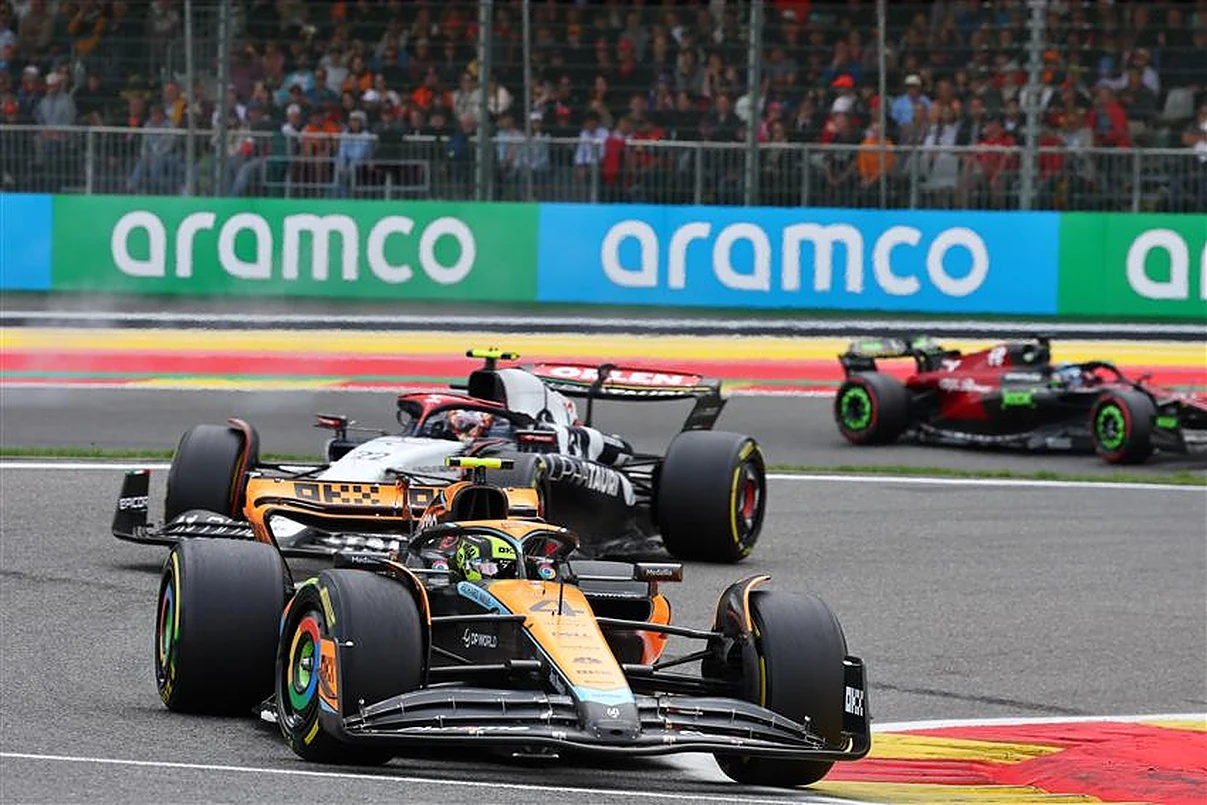
Lando Norris finished second fastest in FP2 at Spa-Francorchamps, but the world champion remains cautious about McLaren’s true competitive position heading into the weekend.
Nearly a full second separated the top six cars during their soft-tyre qualifying simulations in the second practice session at the famous Belgian circuit.
Only Norris came within two tenths of the benchmark set by championship leader Kimi Antonelli, making it appear as though McLaren was in a strong position.
However, Norris improved by nearly 1.8 seconds between FP1 and FP2, and neither he nor McLaren technical director Neil Houldey believe second place accurately reflects where the car truly sits.
“FP1 not great, to be honest – FP2 a little bit happier,” said Norris. “I’m still not very happy with the car – it’s still very, very difficult to drive, but we seemed a bit closer.”
Norris added that McLaren tends to show stronger pace on Fridays than rivals, warning against reading too much into the session results before qualifying and race day.
“But, yeah, we’re certainly not getting ahead of ourselves. I think we shouldn’t expect anything different from normal,” the world champion said.
Spa has always presented teams with a setup challenge, as the first and third sectors reward low drag and engine punch, while the middle sector’s higher-radius corners demand more downforce.
The difficulty has been amplified by the energy management demands of the 2026 power units, with very few opportunities to recharge under braking or via lift-and-coast sections around the circuit.
Norris highlighted electrical deployment as a particular problem, noting that his McLaren was struggling across multiple straights throughout the session at Spa.
“There’s just lack of deployment everywhere,” added Norris. “Every single straight, we lack deployment, to be honest. I think the worst one is through Blanchimont.”
Norris described speeds dropping from around 320km/h to 270km/h through Blanchimont due to the battery being depleted, which represents a significant performance disadvantage on such a high-speed circuit.
Telemetry comparisons between Norris and Antonelli during their qualifying simulations revealed clear differences in how each driver deployed electrical energy across the lap.
Norris lost speed relative to Antonelli on the downhill run to Eau Rouge, suggesting his car was spending less electrical energy at that point of the circuit.
Although Norris enjoyed a terminal velocity advantage of around 5km/h on the Kemmel Straight, Antonelli began super clipping earlier on the approach to Les Combes, opening a gap of roughly three tenths by Pouhon.
McLaren buys its power units from Mercedes, and the works team continues to hold an edge not only in chassis efficiency but also in maximising electrical deployment and harvesting for an optimal lap.
McLaren technical director Houldey was frank in his assessment, suggesting Norris extracted the maximum possible from the car rather than second place reflecting McLaren’s genuine competitiveness.
“I think Lando got the most out of the car as it was in that session, so I don’t think we can say that second is the position we’re truly in,” said Houldey.
Houldey acknowledged that deployment optimisation remains a key area of focus for the team, with work to be done overnight before FP3 and qualifying later in the weekend.
“We just need to spend a lot of time overnight looking at where the opportunities are, simulating a few different things and coming up with what we think is best for FP3,” Houldey added.
Norris also faces a grid penalty this weekend after McLaren took on new power unit components, which will further complicate his race strategy at Spa-Francorchamps.